How it Works: The Runtime Lifecycle
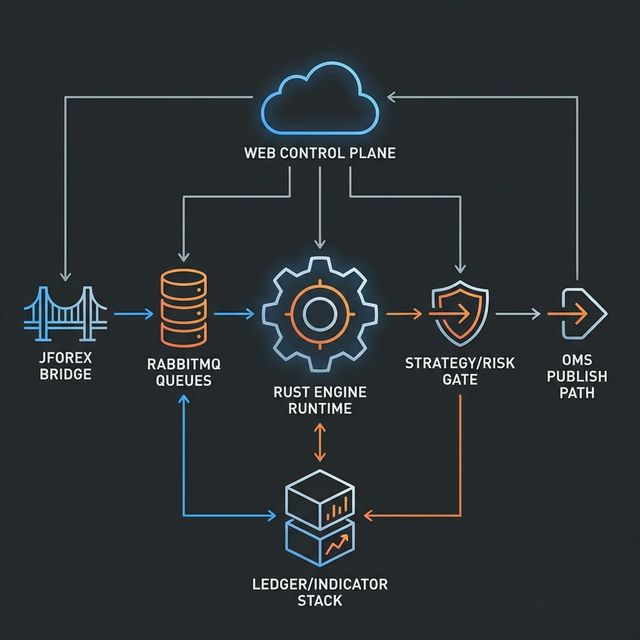
MIDAS ATLAS transforms high-throughput market data into auditable execution logic through a four-stage deterministic pipeline.
05 The Operational Pipeline
A. Message Ingest & Unpack
Market and account messages arrive via the AMQP bridge. The runtime validates data integrity and unpacks them into internal message formats with high-resolution timestamps.
B. Ledger & Indicator Update
Messages update specifically enriched ledgers (Tick, Bar, Depth). Every ledger mutation triggers incremental indicator calculations, maintaining a consistent state-wheelhouse.
C. Strategy Scoring
The current indicator state is scored against strategy logic to generate "execution intents." These intents are theoretical desires for order placement or modification.
D. Risk Gate & Order Flow
Confidence policies and risk gates evaluate the intents. Only intents that pass all safety checks are converted into physical orders and published back to the bridge.
06 Clinical Audit Capability
Because the pipeline is deterministic, any execution event can be audited retrospectively. By replaying the captured market data through the same version of the logic, the system produces the exact same indicator states and execution decisions.
Why Determinism?
Eliminates "drift" between backtest performance and live execution, ensuring that what you validate is what you deploy.
Audit Path: Verified